Leveraging Machine Learning for Smarter Marketing Strategies
The Challenge: Why Traditional Customer Segmentation Falls Short
E-commerce businesses thrive on personalized marketing and targeted promotions. However, traditional customer segmentation methods—such as demographic-based grouping or purchase frequency tracking—are often too simplistic.
In a rapidly evolving online retail landscape, consumers expect highly relevant product recommendations, customized offers, and engaging experiences. Without data-driven segmentation, businesses struggle with:
- High customer churn rates due to irrelevant marketing.
- Low conversion rates from poorly targeted advertising.
- Increased customer acquisition costs from ineffective outreach.
To tackle these challenges, AI-powered machine learning models are transforming how e-commerce businesses identify and engage with their customers. This case study explores how AI-driven segmentation enhances personalization, optimizes marketing strategies, and boosts revenue.
How AI is Revolutionizing Customer Segmentation
AI-based customer segmentation leverages data clustering techniques, behavioral analytics, and predictive modeling to group customers based on actual shopping patterns rather than basic demographics.
Machine Learning for Behavioral Segmentation
Traditional methods classify customers based on static attributes like age or location. AI-driven segmentation, however, focuses on:
- Purchase Behavior → Frequency, order value, and category preferences.
- Browsing Patterns → Time spent on pages, cart abandonment, and product views.
- Engagement Metrics → Email response rates, click-throughs, and interactions with promotions.
Example: A leading online fashion retailer implemented AI-based clustering to categorize customers into distinct groups:
- Frequent Buyers – High-value customers making repeat purchases.
- Seasonal Shoppers – Customers who buy mainly during sales or holiday events.
- One-Time Buyers – First-time purchasers who haven’t returned.
- Cart Abandoners – Users who show interest but don’t complete purchases.
Using AI-driven segmentation, the retailer customized email marketing and promotions, leading to a 23% increase in conversion rates.
Graph: AI-Powered Customer Segmentation vs. Traditional Demographic-Based Segmentation
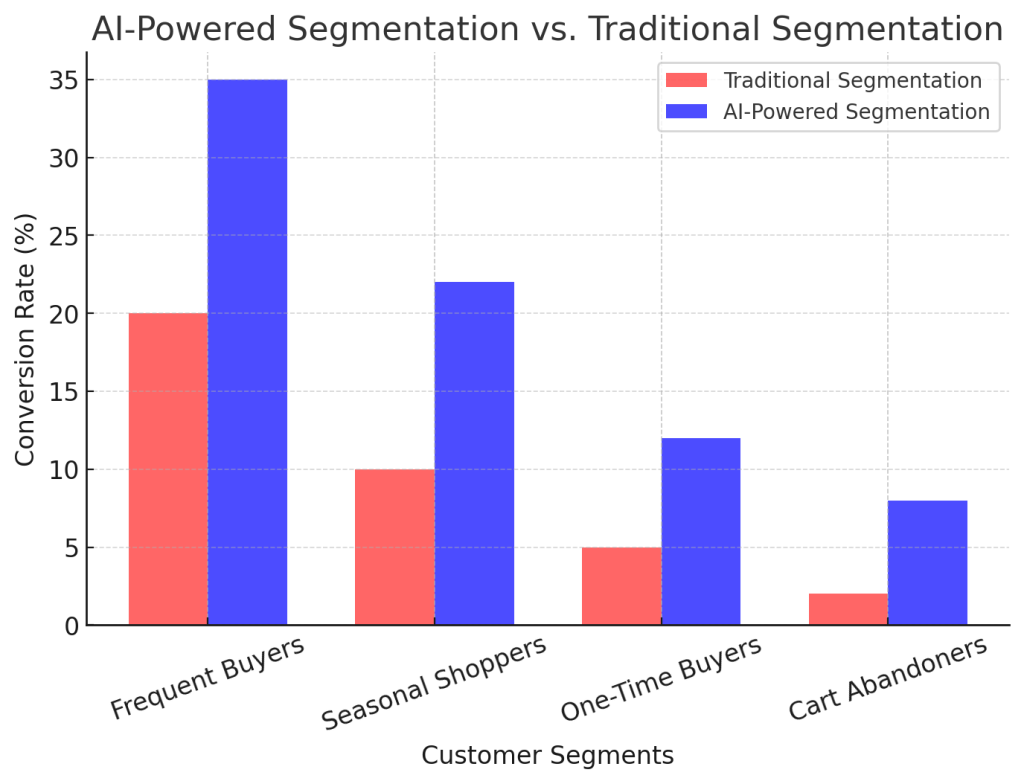
- Red Bars (Traditional Segmentation): Lower conversion rates due to broad, generalized targeting.
- Blue Bars (AI Segmentation): Improved conversion rates across all segments thanks to behavior-based, data-driven marketing.
AI-Powered Personalization & Recommendation Systems
AI segmentation doesn’t just classify customers—it predicts their needs and tailors content accordingly. Machine learning models analyze past behavior to:
- Recommend products based on purchase history.
- Deliver personalized discounts to price-sensitive shoppers.
- Send timely offers to users showing declining engagement.
Example: Amazon and Shopify’s AI-driven recommendation engines leverage customer data to provide hyper-personalized product suggestions, increasing sales and average order values.
Graph: Impact of AI-Based Personalization on Customer Retention
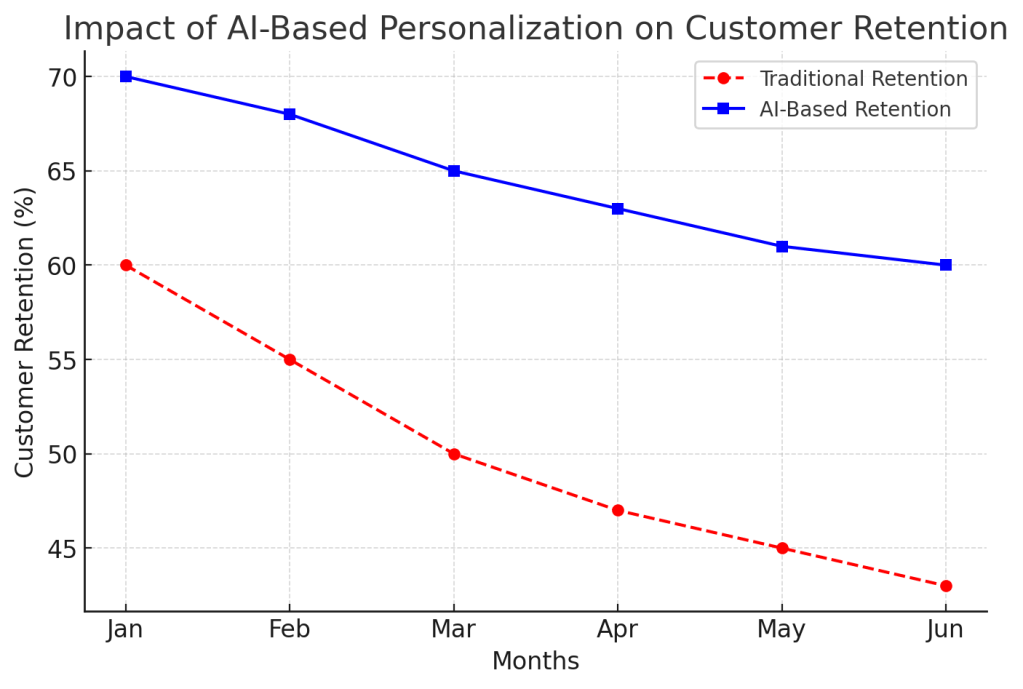
- Red Dotted Line (Traditional Retention): Customers drop off more quickly over time due to lack of personalized engagement.
- Blue Solid Line (AI-Powered Retention): AI-driven recommendations and tailored marketing help maintain higher retention rates.
Predictive Customer Lifetime Value (CLV) Modeling
Understanding which customers will be most valuable in the long run is critical for e-commerce success. AI helps predict CLV by:
- Identifying high-value repeat customers early.
- Optimizing customer acquisition spending based on lifetime revenue potential.
- Reducing marketing waste by focusing on retention rather than one-time sales.
Example: A global electronics retailer used machine learning models to predict CLV and adjusted their ad spend strategy. This reduced customer acquisition costs by 30% while increasing retention rates.
Graph: AI-Driven CLV Predictions vs. Actual Customer Spend
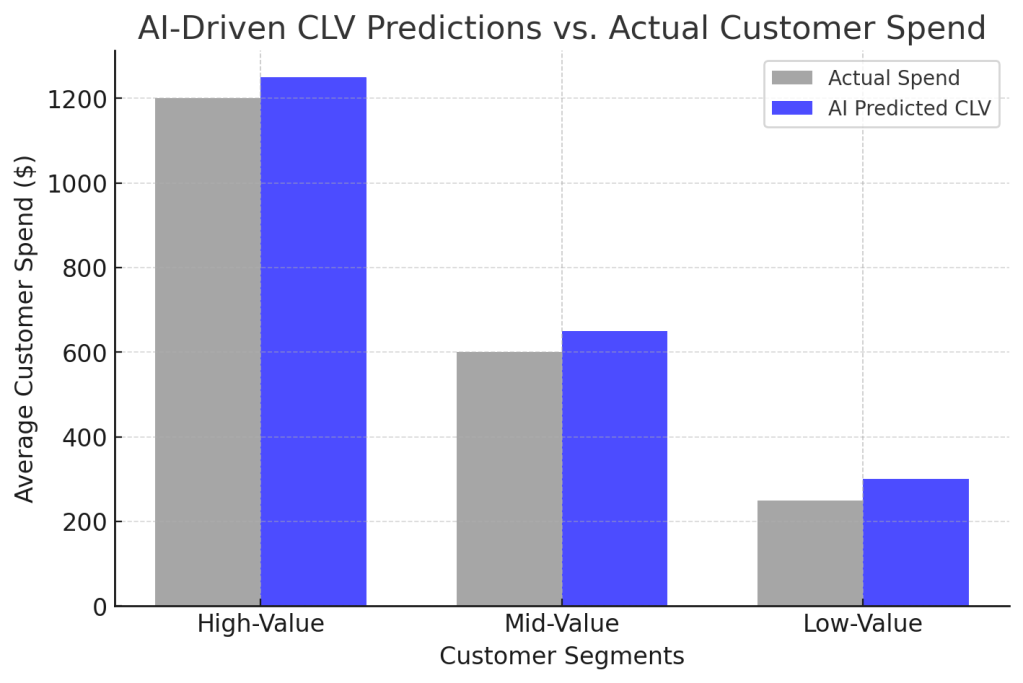
- Gray Bars (Actual Spend): The average amount spent by customers in different segments.
- Blue Bars (AI-Predicted CLV): AI’s forecasted lifetime value for each segment, showing strong alignment with actual spending trends.
Challenges & Limitations of AI in Customer Segmentation
Despite its advantages, AI-powered customer segmentation comes with challenges:
- Data Privacy & Compliance → Strict regulations like GDPR and CCPA require businesses to ensure ethical data usage.
- Algorithm Bias & Fairness → Poorly trained AI models may reinforce unintentional discrimination in targeting.
- Implementation Complexity → Many businesses lack the technical expertise or infrastructure to deploy AI-driven segmentation effectively.
Business Impact: AI-Driven Segmentation in E-Commerce
The implementation of AI in customer segmentation offers significant benefits:
- Higher Marketing ROI – AI helps optimize ad spend by focusing on high-converting customers.
- Reduced Churn Rates – Personalized outreach enhances customer retention and satisfaction.
- More Effective Product Recommendations – AI-driven suggestions increase order value and repeat purchases.
Companies that leverage AI for segmentation see measurable improvements in customer engagement, sales, and overall profitability.
Looking Ahead: The Future of AI in E-Commerce
As AI technology advances, future developments in customer segmentation will include:
- Real-Time Adaptive AI Models – Systems that adjust marketing strategies dynamically based on live user interactions.
- Cross-Channel AI Integration – Synchronizing AI-driven insights across email, social media, and in-store experiences.
- Conversational AI & Chatbots – Personalized shopping assistants powered by AI to enhance customer interaction.
AI isn’t just transforming e-commerce—it’s reshaping how businesses understand and connect with their customers.
Final Thoughts
AI-powered customer segmentation allows e-commerce businesses to move beyond traditional marketing approaches and embrace data-driven personalization. By leveraging AI for predictive analytics and behavioral segmentation, businesses can create highly relevant, engaging customer experiences while optimizing marketing spend.
 DataZap